Vogue Summer School: The Kids, The Classroom, and The Industry
The September’s Issue is out. Rob Haskell is a good writer, he undoubtedly crafted a compelling feature interview with Kaia Gerber and Homer Gere. The penmanship is structured, eloquent, and clear. What’s missing is the flair, the joy, the novelty of it all: nepo babies are so old news, no matter how extraordinaire and gorgeous they are. Lots and lots of students at Vogue Summer School, despite the appearances, are tired of these narratives and are craving for fresh educational content. Vogue’s not there yet.
Chiseled-jaw, big hazelnut eyes, and a million-dollar smile: Kaia is spectacular. On the other hand, Homer reflects a calm demeanor: he appears the guy the next door, whose social media presence is barely existent, who just happened to find a love for films, and voilá, a Vogue cover is now part of his Hollywood portfolio. Cute, not sexy; attractive, but not striking: several people on social media are already arguing over a lifeless Vogue cover, and this is not the first time that has happened since Chloe Malle has stepped into her leadership role at Vogue. After seeing and hearing her talking with the students at Vogue Summer School, I’m yet to be surprised: there’s nothing bad or good about Chloe, but there’s also nothing about her that is mesmerizing or captivating; she just is, hence Vogue is what it is. It’s like they’re saying “we’re not daring, we just exist”, “we don’t jump nor blast off, we skip and hop on the ground.” Safety is the right word, and who can blame Chloe or Vogue to go towards that direction when the world around us, the politics of all, society at large demands us to be so “safe”? However, the next generation of media consumers want more from these current times and they will be the ones building the real new horizons. Vogue Summer School might be cultivating new talents and fresh, much needed, structures within the media landscape.
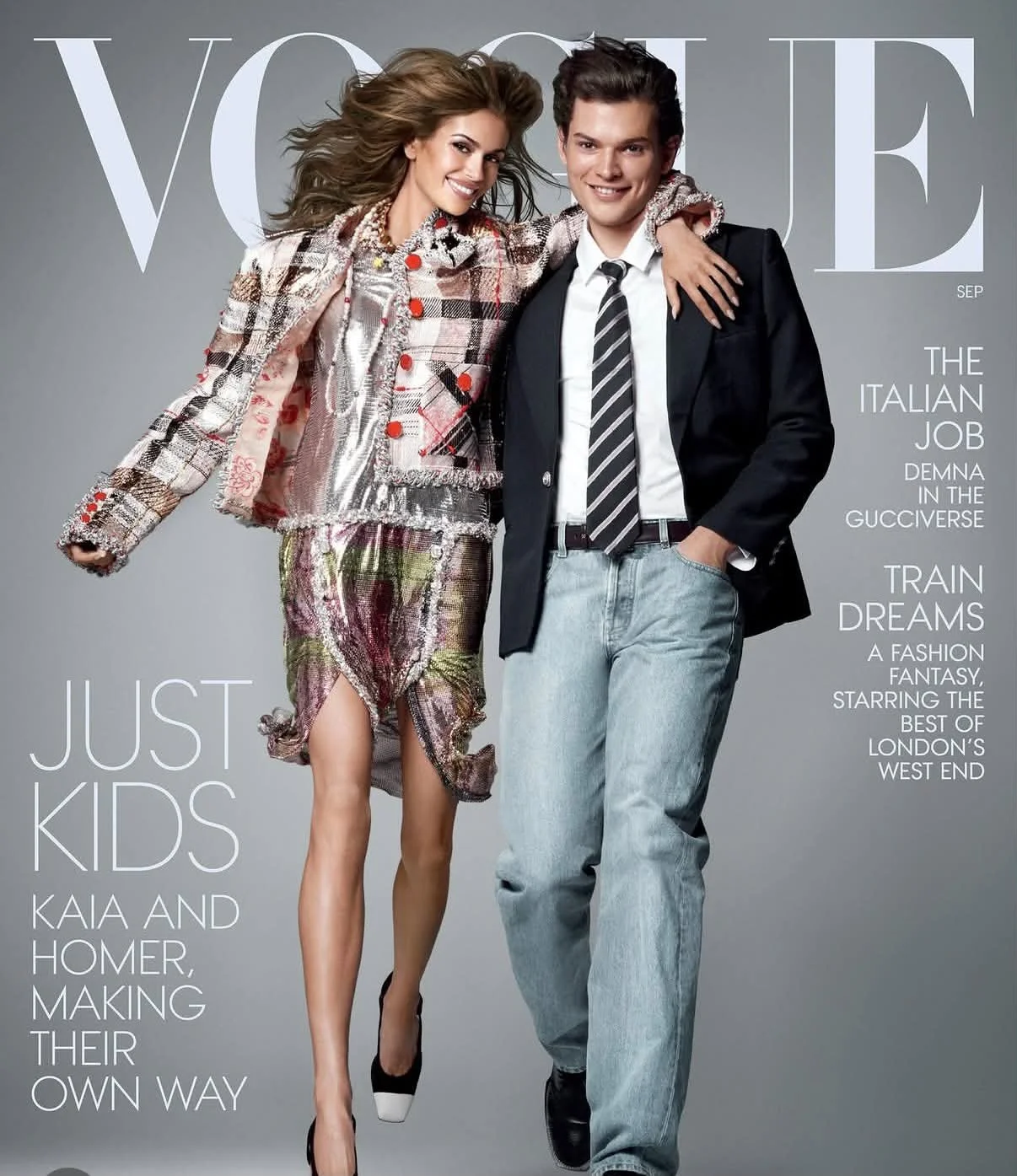
Kaia Gerber and Homer Gere wear Chanel. Fashion Editor: Spencer Singer.Photographed by Steven Meisel. Vogue, September 2026. Cover look description from Vogue.com.
What Is Vogue Summer School?
Vogue College of Fashion is a pre-college education initiative that started in the early 2000s in the UK. Followed by its arrival in Spain, last year they launched its pilot program in the United States, with Vogue Summer School (VSS) being its most popular program for teenagers and early college students. The program lasts two weeks, during which students learn about particular aspects of the fashion industry (based on the specific course the students enroll in) and get to experience one-of-a-kind on-site visits at Condé Nast, The Costume Institute at the Metropolitan Museum of Art, and other exclusive fashion and beauty companies. Vogue College of Fashion hires faculty members who will teach courses on fashion business, fashion styling, and fashion media based on their expertise and academic scholarship. I have been a fashion media instructor since 2025.
The Kids at Vogue Summer School
Attending Vogue Summer School is not for everyone. Although there are a few scholarship opportunities, majority of the students apply and get into the program after paying thousands of dollars. In addition to traveling expenses, food, shopping sprees, and small emergencies students might come across during their stay (e.g. last minute toiletries), this whole experience’s cost can easily reach the five figures ($10K and a change). I’m not here to pocket-watch anyone, but it goes without saying that in this program you, as a faculty or staff member, are surrounded by many wealthy kids. Some of them might be nepobabies themselves, but even those ones are tired of seeing people who look like them on the cover of fashion publications. The kids want more. The kids at the cusp of Gen Z and Gen Alpha, the bright ones among the mass, if they know how to play their cards right, will be the real movers and shakers of the next fashion media scene; my generation, the one at the cusp of Gen Z and Millennials, has been hit by too many rapid and profound casualties (COVID, the advent of AI, etc.), while simultanously getting little to none of the promised change from the previous generations. That’s why I am not surprised to have witness so much creativity and willigness to break the ceiling in many of my students’ projects and assignments, but I have quite yet to see all of this joyful sentiments being repurposed into Vogue, the magazine, the empire itself. We might need a nother generation of fashion media professionals to achieve that.
What the Classroom Taught Me
For many students, the program offers a first introduction to the fundamentals of fashion writing and journalism. But what makes Vogue Summer School distinctive is that it also gives faculty the opportunity to bring their own scholarship and professional experience into the room, provided it is calibrated to the audience and remains respectful of the industry it serves. Throughout the program, I made a deliberate effort to foreground conversations around media literacy, intercultural communication, and media accessibility, which are themes I consider essential, not peripheral, to lifestyle journalism today (fashion writing included). My students, and the assistants who supported each faculty member throughout the program, can attest to how consistently these threads ran through my teaching. Teaching did not just inform my students, but also informed my own research. Being in the room with them gave me an unfiltered view of what genuinely interests this generation. I found many students eager to engage more deeply with sensitive subjects: they really care about media representation, body image, and mental health. And yes, they’re sick and tired of seeing nepo babies all over the place and in each space they enter: they’re not that cool anymore.
What struck me most was the paradox these students navigate daily. They are remarkably receptive, yet also under constant pressure from the demands a hyperconnected society places on them. Many use an iPhone not necessarily by choice, but by necessity. They’re constantly micro-managed, and this is something that I, for example, don’t remember from my teenage years. They rely on social media to stay in touch with their peers largely because no comparably fast, reliable alternative exists. Staying current is less an aspiration than an obligation.
And yet, they are equally intent on learning how to do this without becoming fully dependent on the digital. This is not a desire to go backward, bur more so is a desire to rediscover real-life, in-person experience — while still remaining fluent in the digital world they've grown up in. What they are really seeking is coexistence: a fluency that spans both the digital and the print worlds, rather than a choice between them.
Why This Matters for Vogue and for Fashion Media at Large
This is precisely why I believe a program like this benefits Vogue as much as it benefits its students. It offers the brand a direct, ground-level understanding of what captures, and holds, an audience's attention, and by extension, what it takes to keep a clientele engaged and satisfied.
More broadly, I believe the fashion industry would benefit from a stronger educator presence within its media space, just as it has long embraced educators within styling. Education and industry should not operate as parallel tracks; they should form a genuinely interconnected passage, one in which educational institutions draw on real industry practice, and the industry, in turn, draws on the insight that only sustained pedagogical engagement can offer. This reciprocity, I believe, is the future of fashion media: sustainable, conscious, and shaped by lifelong learners and eclectic-taste experts.
I was hoping this Vogue’s September issue could reflect the joy and the sentiments of what the students, who love and consume Vogue, want. Nevertheless, Kaia and Homer look very cute together, and Steven Meisel never misses a perfect shot with that lens of his.