On Working in a Catholic School, Dealing with Social Media, and Framing my Research
Since summer 2024, I’ve been scouting new opportunities that could keep me afloat in both academia and media. In Italy, we have a saying that goes “essere né carne, né pesce,” which translates to “to be neither meat nor fish.” It has taken me a year to figure out who exactly, in detail, I want to become and show up in these spaces - higher education and the publishing industry.
This time last year, I was teaching a challenging class of difficult students at Lehman College (CUNY). It was my third semester teaching, fourth group of students, the third batch of first-year students under my vigilance. So far, that has been the most arduous class to work with. Even though I was still determined to keep teaching, I felt stale in the materials I offered, stuck in a loop of theoretical discussions that were neither stimulating nor advancing my research. I sensed some resentment toward my role as an adjunct in that particular class, department, and school, and it wasn't a good feeling - mind you, I love Lehman College and the whole CUNY universe for what they have provided me.
Without thinking twice, I reembarked on my grant-writing journey and started working as a part-time program assistant at a local private university, Saint Peter’s University. I also worked with Vogue and expanded my academic network in ways I never thought I could, especially by participating in conferences. Compared to this time last year, my morale rose, I enthusiastically bounced back with my research, and my passion for teaching fashion media literacy quickly rebounded. One bad class doesn’t make for a bad higher-education experience, and that is the truth I have proof of.
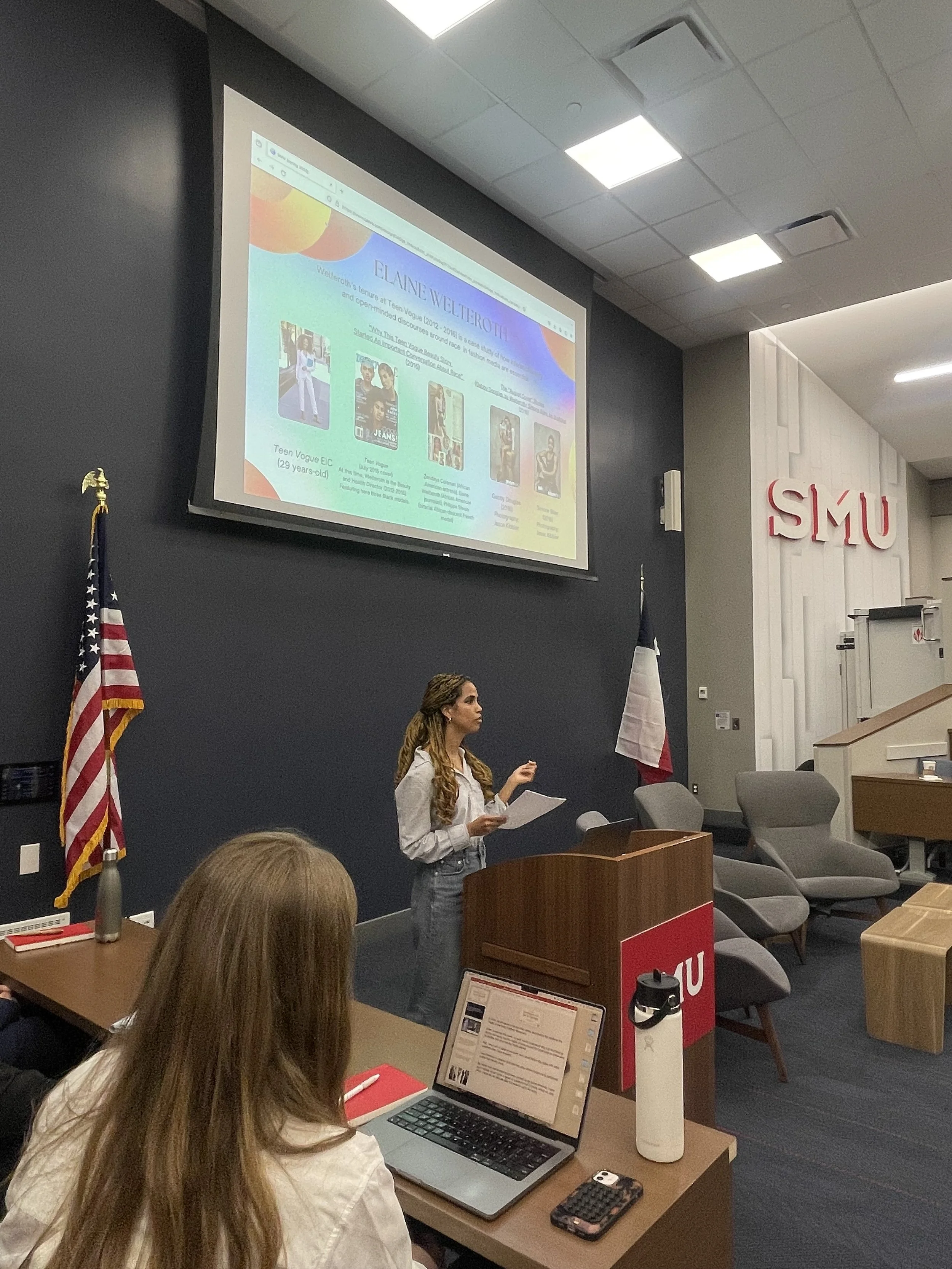
Once I was on the podium, I was at ease. It was a great experience (Dallas, TX)
Diversification of Schools and Roles
I was called crazy by some of my peers and family members for having this goal: by 2026, I want to have gained experience teaching (or working as a grant writer) at four schools - one community college, two public universities, and one private college. It’s December 2025, and I’ve accomplished more than I had imagined in December 2024:
presented at two academic conferences (up until last year, I thought I couldn’t possibly belong to these spaces as a first-gen, let alone someone who is not enrolled in a PhD program)
elevated (exponentially) my academic network
gained confidence in applying to several PhD programs (the process was daunting, but to be in touch with specific faculty members whose research made me so excited about my trajectory into academia and media, while learning from their experience has been fantastic)
taught at a community college, maintained relationships with two public institutions, and worked as an administrator in a private Catholic school
Presenting at two academic conferences marked a significant professional milestone, one I once believed was beyond my reach as a first-generation scholar who is not enrolled in a PhD program. Earlier this year, I experienced some validation (finally!) when my paper was accepted to the Fashion Media Symposium at Southern Methodist University’s Meadows School of the Arts. In that moment, I truly questioned whether I had made it - whether I was capable of producing scholarship that might matter. I presented the paper with confidence and received constructive critique that encouraged me to more rigorously situate my work within communication literature, drawing upon a range of sources from lifestyle writing to theoretical texts, and to continue developing this research.
Of the more than 200 students I have taught to date, only one class from the 2024 fall semester was genuinely disappointing, and even then, only half of the students failed to meet the expectations I had set. Many in that cohort seemed ill-equipped to navigate a college environment. They lacked the foundational resources necessary to meaningfully participate in class discussions - circumstances that, in hindsight, were not reflective of my instruction. During that period, I recognized the need to explore a new professional environment, which led me to apply for a Program Assistant position with the Campus Ministry Office at Saint Peter’s University. I was particularly drawn to this role because of the Bienestar Grant, a government-funded initiative dedicated to the well-being of students, faculty, and staff, and because of my personal connection to Saint Peter’s: having received a Catholic education in Italy from kindergarten through high school, I wanted to reconnect with aspects of my upbringing that I had set aside in the process of assimilating to life in the United States, especially during a challenging time of waiting for adjustment of status and restricted travel home. I now feel more grounded in my identity and fortunate to be able to be selective about where I work - a privilege that, as a former international, I don’t take for granted. I am also deeply grateful for a partner who provides steadfast support and positivity in our belief in our career paths and community service.
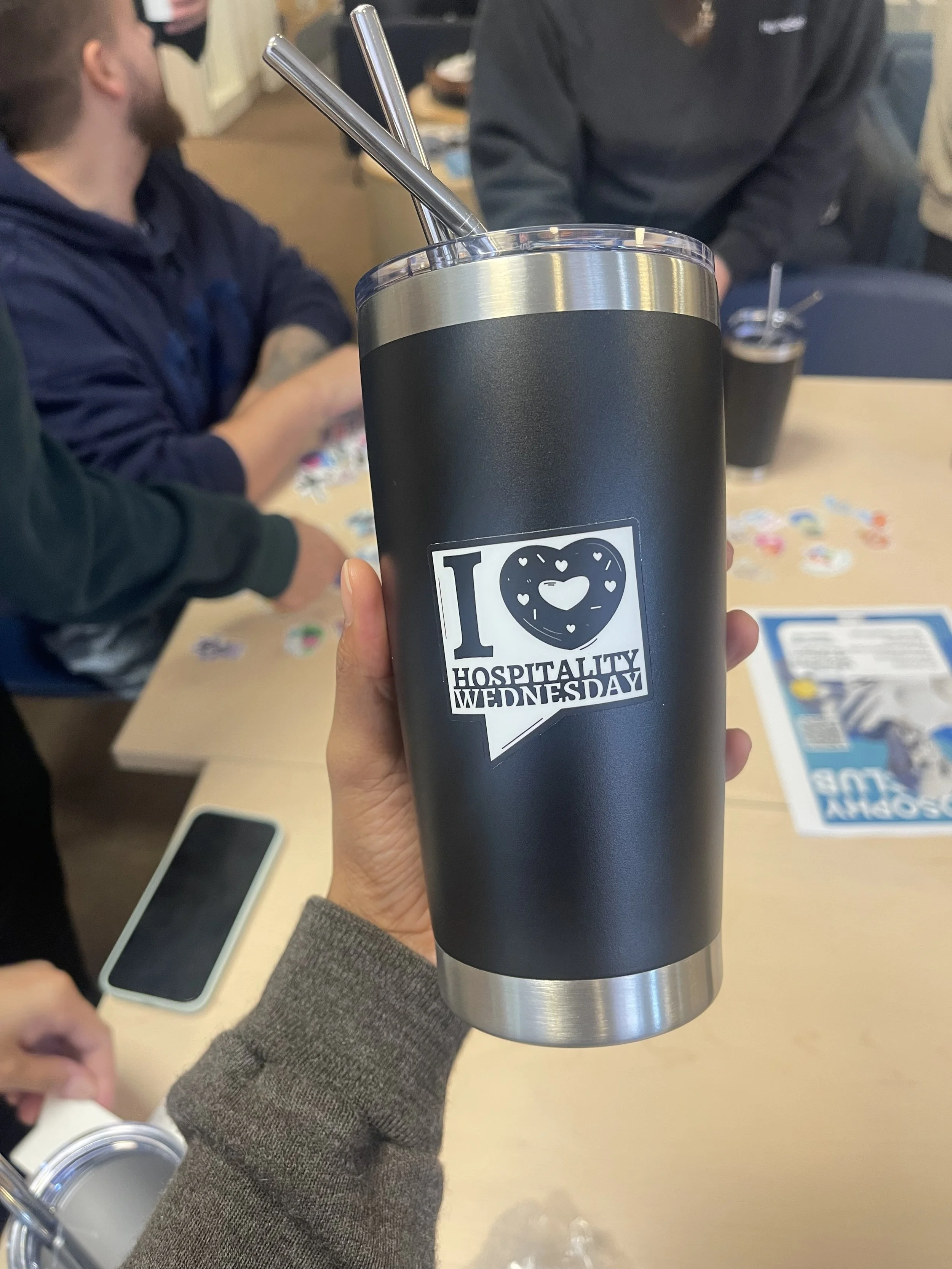
Hospitality Wednesdays are weekly gatherings open to faculty, students, and staff. During these meetings, I got the chance to have inspiring chats and learned so much from my colleagues - as well as from the students.
Although I am not a practicing Catholic, being part of a diverse team that embraces Catholic cultural experiences without judgment has been affirming for both my self-esteem and my faith in higher education. While Saint Peter’s is a service-oriented and teaching institution, and my long-term goal remains a faculty position at an R1 university, this environment has been profoundly good for my heart and mental health. I was sad for having to decline a lecturing role in their English department due to HR policy prohibiting holding two roles on campus, but I have nonetheless found great joy working alongside faculty as an administrator and engaging with students.
This fall, my participation in the NWSA conference was transformative just like the one in Dallas, TX at SMU. I had not fully appreciated the stature of the conference until I was accepted and committed myself to presenting the most refined version of my updated research. At both conferences, I engaged with scholars and students whose insights prompted me to reevaluate my professional trajectory and potential within higher education. These experiences have affirmed my desire to pursue a tenure-track faculty position at an R1 institution while maintaining active involvement in the publishing industry and in collaborative media initiatives, such as those with Vogue College of Fashion.
The experience at Vogue College of Fashion as a fashion media instructor was so enlightening. It was like doing what I’ve been doing at FOTB on steroids (and of course… with a much more refined infrastructure and financial support). That teaching experience sealed the deal: I want to be in fashion media, but I want first and foremost to become a refined fashion media scholar, pouring my work into the fields of communication and media, with both theory and practice. Teaching will have its ups and downs, but I can’t let one bad experience dictate my whole career.
And now, here we are. I’m not sure where I’ll be next year. Maybe I’ll still be lecturing as an adjunct, or I might enroll in a doctoral program. Balancing my role at Saint Peter’s with the lecturing roles at Hudson County Community College, Lehman College, and New Jersey City University (spring and summer 2025) has been rewarding and sustainable, until the demands of preparing PhD application materials reminded me of the elevated stakes and burning desire that accompany this next phase. Regardless of the outcome of my PhD applications, I remain committed to showing up for myself and for these roles in the most effective and meaningful way possible, while continuing to nurture my scholarship. Whatever I’ll do, I’m set with my purpose, and now I know exactly how I want to show up in real life and in the virtual space - a service of love for my community and me. As a scholar, I also figured, the work that I do is not just for me: I gotta know how I can show up for others in the landscapes we’ve got.
The Digital Footprint of a Zillennial Scholar
This past year, as a journalist transitioning into academia, I've been strategizing how to curate and shape my digital footprint going forward. I know what I can do within my capacities and how I can realistically show up in a digital environment without compromising my mental health.
1) I must not compare my behind-the-scenes to someone else's highlight reel.
2) I know my experience is the paramount goal for someone else. I must be proud of my journey, no matter what.
A good friend of mine, years ago, suggested reflecting on this prompt: "Think about the people that inspire you - how do they show up on social media?" I analyzed how certain media professionals (in fashion, beauty, and content creation), and some academics show up on social media, as well as some of my friends - those who are influencers, in academia, or work in social media/influencer marketing. I now have a clear idea of how I want to encapsulate my talent and enjoy my digital presence. It's refreshing.
When it comes to establishing myself in academia, I've concluded that my digital presence matters only up to a point. What really matters in academia is publishing research in highly niche, particular spaces. Fame is marginal and contingent on how much and where you publish your work, plus how you conduct your research within the proper structures that enable this kind of editorial production.
Fashion writing versus academic writing are two different beasts and crafts. They're an art. One is warm, the other is cold; the first praises the aesthetic effects and the sparkle of human behavior, the second questions everything you can possibly think of; both are so necessary. Both are, in some way, absurd - if not "weird" or "brutal", yet mesmerizing and stimulating. To bring these two types of editorial practices and productions together in a digital space while maintaining a polished, professional, and personalized digital presence (that can both attract and retain a specific kind of audience) is tough. Not impossible, though. I also want to bring this kind of knowledge into the classroom, and I have now proof that within my small capacities I can do that - by attending conferences, lecturing (even though my impact is low), and freelancing (example: collaborating with Vogue College of Fashion).
I am confident I can enter my 30s with a well-crafted, healthy digital presence as a media and communication scholar. Whether or not I get a PhD - it would be nice, but I’m aware of the current status of education and the competition I’m against. Still, fashion media literacy, here I come.
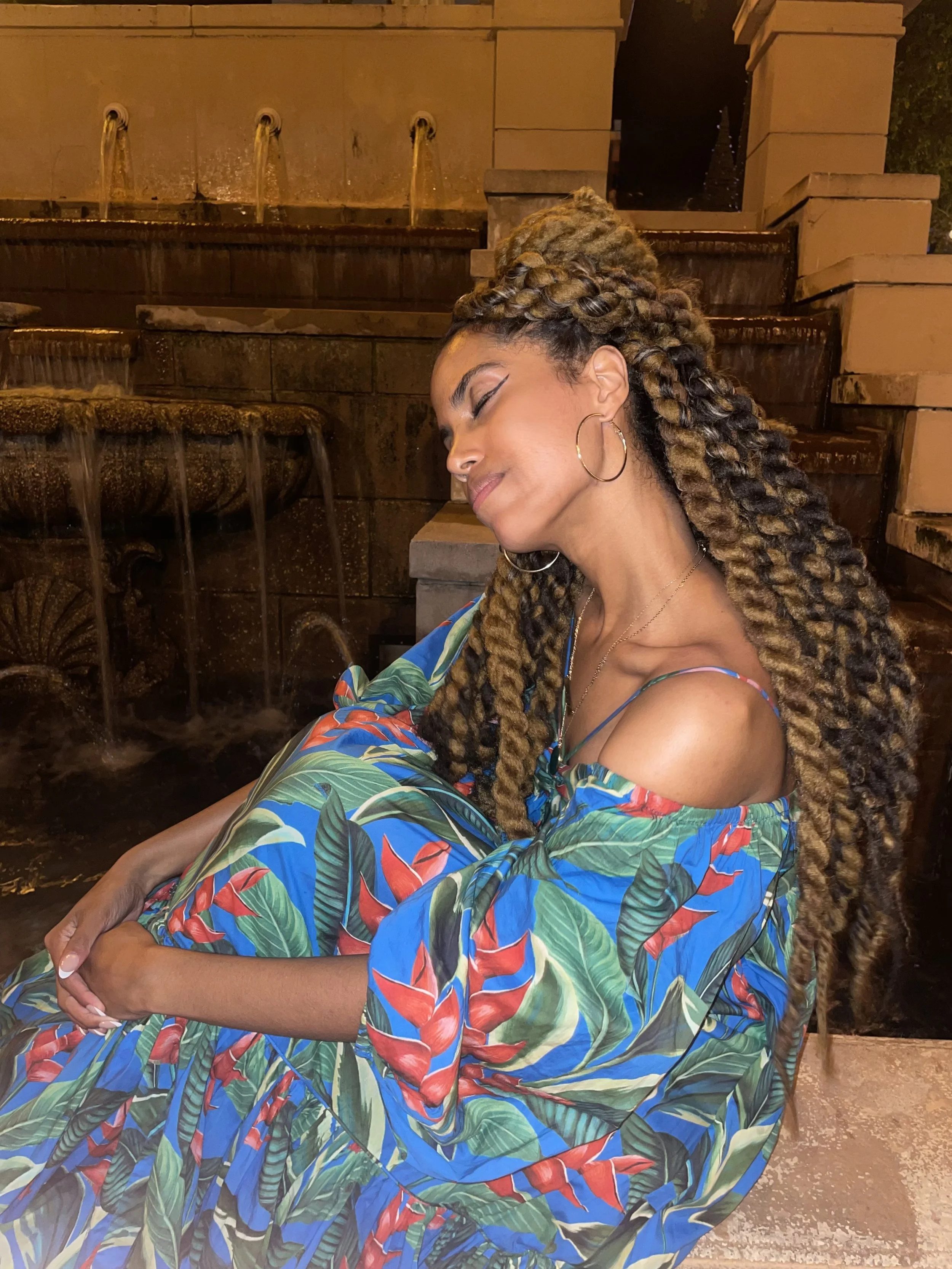
Feeling grateful after presenting at NWSA (San Juan, Puerto Rico)
Fashion Media Literacy: This is What I Wanna Do
With McLuhan’s understanding of “media” as a collection of communication modalities and channels in tandem with “literacy” as a combination of information and knowledge, fashion media literacy becomes a rich socio-cultural space in which human behavior, identity formation, and aesthetic practices converge. To comprehend the concept of fashion media literacy, one must go beyond glossy covers, celebrity endorsements, and superficial style analysis. Media literacy approaches fashion as an interdisciplinary background, which demands the capacity to interrogate how images are selected, produced, and distributed, and to connect those visual and textual processes to lived sociocultural phenomena.
Viewed through the lens of dress theory, which understands dress as a system of body modifications and supplements that communicates and constructs identity, fashion entails far more than garment production or viral-trend forecasting. It becomes an entry point into examining creative labor, identity negotiation, and the self-branding practices that increasingly shape the lives of Gen Z and Gen Alpha individuals - who are often on the lookout for alternative approaches to media education and civic engagement discourses (Tafonao et al. 89-98). Fashion media literacy can gain academic validity when situated within BIPOC and BAME experiences, thereby blossoming into Black fashion media literacy. This layered version of fashion media literacy focuses on interpreting visuals, content, industry dynamics (the mechanisms of the industry), and media (the collection of editorial content and cultural messages). It also emphasizes the diverse experiences BIPOC and BAME members face as they become media professionals in the fashion industry.
I don’t know which schools I will keep interacting with or what resources I will obtain to prove this kind of work. All I know is that for now, this is what I wanna do and that I know, for sure, it can resonate with future fashion scholars, media professionals, and more.
I’m looking forward to next year and what it will bring.